Fairfax City vs Fairfax County Property Tax: Look Beyond the Rate
October 1, 2026
October 1, 2026
When Fairfax City Council closed out its fiscal year 2027 budget on May 5, Patch reported that Councilmember Stacy Hall described the process behind it as "months of careful work, collaboration and tough choices." A few miles away, the Fairfax County Board of Supervisors adopted its own budget numbers that same day. Both governments landed below what they had floated earlier in the process. Only one of them ended up cheaper than its neighbor on paper. The City of Fairfax's real estate tax rate, set at $1.0725 per $100 of assessed value, now sits below Fairfax County's $1.12.
For a buyer comparing two similarly priced homes, one inside the city limits and one just outside them in unincorporated Fairfax County, that gap looks like a straightforward discount for picking the city address. It isn't quite that. The lower real estate tax rate does not by itself show whether a household's total costs went down. The City also raised taxes on meals, hotel stays, and business receipts.
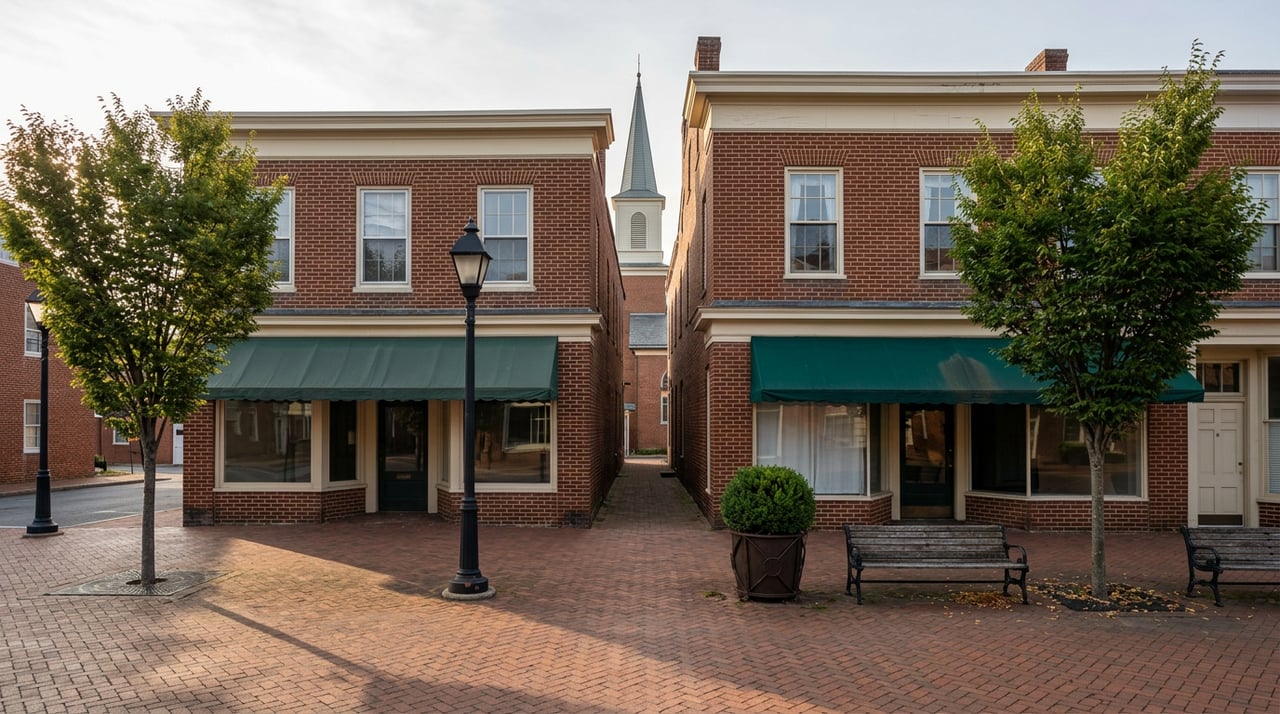
The confusion starts with the map. The City of Fairfax is an independent city, a legal status Virginia uses for a handful of places that operate entirely outside county government. It runs its own police department, its own school division, and its own budget process, all inside roughly two square miles centered on a walkable historic downtown near George Mason University, mostly within ZIP code 22030. Its population is somewhere around 24,000 to 25,000 people.
Fairfax County surrounds it on every side and is a different animal entirely: well over a million residents spread across Tysons, Reston, McLean, Vienna, Burke, and dozens of other communities, nearly all served by Fairfax County Public Schools rather than the City's own system. When someone says they live "in Fairfax," they almost always mean the county. The people who actually live inside the small independent city are a much smaller group, and their tax bill, school assignment, and even trash pickup come from a completely separate government.
That distinction matters more this year than usual, because the two governments' rates just crossed.
Fairfax County's Board of Supervisors proposed holding its rate flat at $1.1225 per $100 back in February, even as County Executive Bryan Hill flagged a projected $131.5 million budget gap. By the time the board finalized its FY2027 numbers on May 5, the adopted rate had come down slightly further, to $1.12.
The City of Fairfax followed a similar arc from a different starting point. Its council had advertised a rate of $1.095 per $100 earlier in the budget cycle. The final number adopted on May 5 came in at $1.0725, a shave of more than two cents below what had been publicly advertised. Hall put the practical effect in dollar terms for the average-priced home in the city: about $462.50 more for the year, roughly $335 of that from rising assessments and about $127.50 from the rate increase itself.
"This budget positions the City for future success by creating debt capacity for the future."
That line, quoted from Acting City Manager Bryan Foster in Connection Newspapers' coverage of the prior year's budget rollout, points to something worth sitting with: the City's real estate tax has been climbing for several budget cycles running, even as this year's final adopted rate sits below the county's. A year earlier, city officials had floated a hike that would have pushed the rate to $1.125, nearly the same level Fairfax County is currently charging. The council didn't go that far. But the fact that it was even on the table is a reminder that this year's flip in the rate comparison is a snapshot, not a fixed feature of living inside city limits.
A lower real estate rate doesn't mean the City collected less money. Real estate tax has historically made up close to half of the City's General Fund revenue, and officials didn't want to lean on it any harder than they already had. Instead, the same May 5 budget vote raised three other taxes at once.
The meals tax moved from 4 percent to 4.5 percent on July 1, 2026, a half-point increase city staff estimated would generate about $1.3 million a year. The transient occupancy tax, the tax charged on hotel stays, also rose far more dramatically, from 4 percent to 10.5 percent; city staff projected it would bring in roughly $812,500 annually. And for the first time in more than three decades, the City raised its Business, Professional and Occupational License tax, moving the rate for professional, financial, and real estate services from $0.40 to $0.45 per $100 of gross receipts, with repair, personal, and business services rising from $0.27 to $0.30.
Utility bills went up too. Wastewater rates rise 6 percent to help fund more than $100 million in required upgrades at the Noman Cole treatment plant, driven by stricter federal regulations, and the stormwater fee climbs 5 percent to $36.02 per billing unit. None of that shows up on the real estate tax rate line, but all of it shows up in what it actually costs to own a home inside city limits.
The logic city officials gave for the shift was straightforward: a diner from outside the city pays part of the meals tax increase, a visitor pays the hotel tax, and a business absorbs the BPOL increase before it ever touches a homeowner's bill. Whether that trade nets out better or worse for any individual household depends entirely on how often that household eats out in the city, whether it owns a business licensed there, and how its water and sewer bill compares to what it would pay under Fairfax County's utility structure. There's no single answer that applies to every buyer.
Fairfax County had its own reason for not needing a bigger rate increase. Non-residential real estate values in the county were projected to grow for the first time in three years, up about 0.92 percent, and the county's direct office vacancy rate dropped for the first time since 2019, helped along by more than 900,000 square feet of aging office space demolished in 2025 against only 320,000 square feet still under construction. A recovering commercial tax base gave the Board of Supervisors more room to hold the rate closer to flat rather than raise it.
That's a different mechanism than the City's consumption-tax pivot, but it points at the same underlying truth. A residential real estate tax rate is downstream of a much bigger set of decisions about who else is paying into that government's budget, whether that's businesses, visitors, or a recovering commercial market. The rate a homeowner sees on the assessment notice is the number left over after those other decisions get made.
Even with the county's rate essentially flat, assessments in Fairfax County are projected to rise 3.6 percent overall for this cycle, largely from residential properties. A flat or slightly lower rate applied to a higher assessed value still produces a higher bill. The rate and the bill move somewhat independently of each other, in the county as much as the city.
Even within the City's two square miles, the citywide rate isn't the only number that applies. Properties inside the Old Town Service District, a defined area within the city's historic core, have carried an additional real estate levy on top of the base citywide rate, layered on to fund services specific to that district. Whether that add-on shifted when the citywide rate reset for FY2027 is the kind of detail that changes from year to year and needs confirming against the current year's assessment notice rather than assumed from a prior cycle.
The point isn't the exact number. It's that "the city rate" isn't actually one number for every parcel inside the city limits, any more than "Fairfax" is one government for every address that uses the name.
Before comparing a City of Fairfax address against a Fairfax County address on a spreadsheet, a few things are worth confirming directly rather than assuming from the listing:
Our Fairfax neighborhood guide is a starting point for understanding how the city core and the surrounding county areas differ block by block, and a current home value estimate is a useful gut check before treating an assessed value as a stand-in for market price on either side of the line.
Does living in the City of Fairfax change which schools a child attends? Yes. The City of Fairfax operates its own independent school division, entirely separate from Fairfax County Public Schools, which serves the surrounding county.
Is the rate gap between the city and county large enough to decide a purchase on its own? On the rate alone, probably not for most buyers. The bigger variables are how much a specific parcel's assessment moved this cycle, what utility and service charges come bundled with the bill, and which services that household actually uses, since those are the pieces that turn a headline rate into an actual annual cost.
If you're weighing a city address against a county one and want the real numbers pulled for a specific parcel before you write an offer, that's exactly the kind of jurisdiction check Leah Webster runs for buyers across the Fairfax area every week.
This article is general information, not legal, tax or financial advice. Consult a qualified professional about your situation.
Stay up to date on the latest real estate trends.
With over twenty years of experience in real estate, I am proud to be your full time real estate partner. I can help you find property in the toughest of markets and personal situations. I will represent your investment with integrity to net you top dollar, no matter the market conditions.