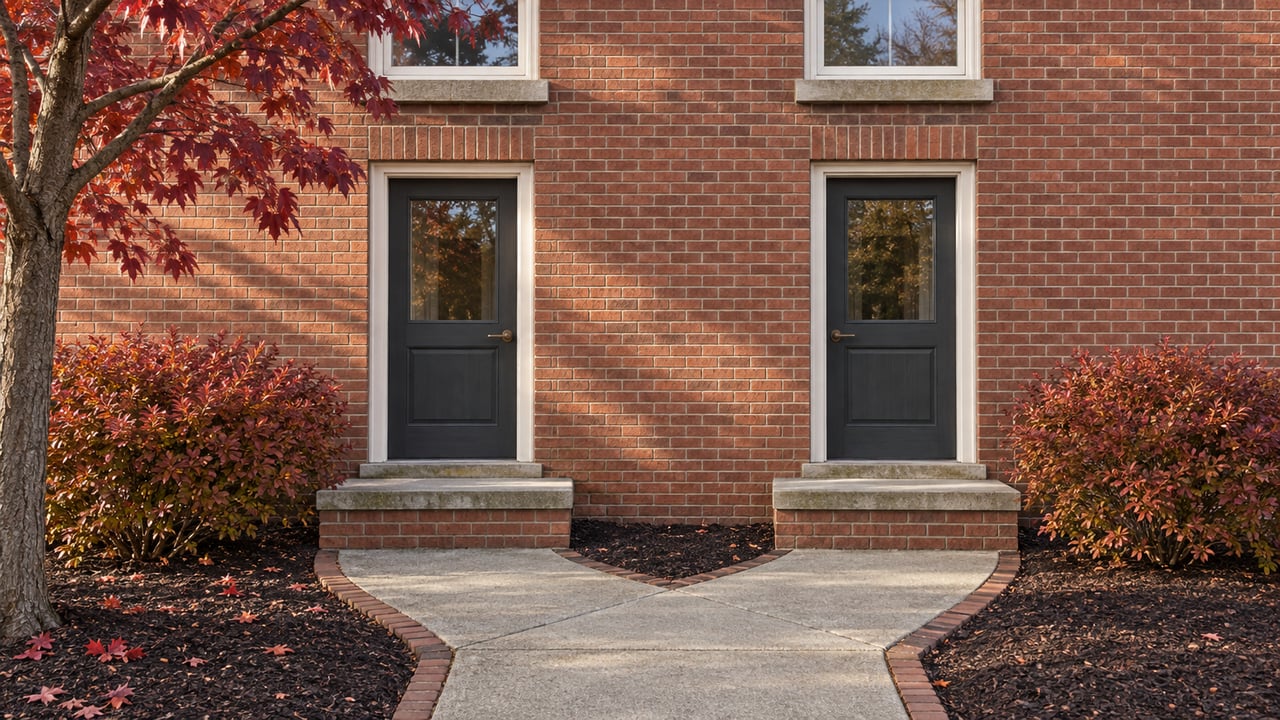
Arlington's Missing Middle Homes Sell Below New Single-Family Prices. The Land Records Explain Part of the Gap
October 22, 2026
October 22, 2026
"To potential purchasers, please be advised that a lawsuit is on appeal to the Court of Appeals that may void your zoning rights to this property and may result in your right to live in this property being eliminated."
An Arlington Circuit Court judge ordered that sentence placed in the land records of homes built under the county's Expanded Housing Option, the zoning change most people call Missing Middle. Most buyers would expect to find it in a title report, not a listing description. It also helps explain why EHO duplexes, semidetached homes and townhouses can sell for much less than the new single-family houses going up on the same streets.
On Wednesday, October 28, the Supreme Court of Virginia hears Nordgren v. County Board of Arlington. If you are touring one of these homes this fall, the hearing matters to you. It will not settle the question the notice raises, though.
The Arlington County Board adopted EHO in March 2023. It allows buildings of two to six units on lots that had been zoned only for single-family homes. On September 27, 2024, a circuit court judge struck it down, finding that the county had not followed proper procedure and had not adequately considered localized impacts. ARLnow reported the ruling at the time and has followed the case since.
A month later, on October 25, 2024, the same court let the 45 EHO permits issued before October 27 move forward under a partial stay with conditions. One condition was the land-record notice quoted above, and the county had to confirm it was recorded before issuing any further permits on the property. On November 13, 2024, an amended order extended the notice to any structure allowed under EHO, "including but not limited to semidetached, townhouses, duplex, three-plex, four-plex, five-plex or six-plex housing units."
The county's own FAQ gives a longer version that also mentions a possible appeal to the Supreme Court of Virginia. Since there are two published versions, the wording that matters for any particular house is the one recorded against that parcel.
The trial judge described the buyer's problem directly. According to the Court of Appeals' later account, the judge said that if a builder finished a project and sold it before the appeal was resolved, the buyer "will have bought a house that it prohibited," and would then have to "call the builder; is the builder going to accept responsibility for that?" In May 2025, an EHO developer told ARLnow the notice was "a cloud on my title."
Since that order, the case has gone back and forth on procedure, and the merits haven't moved:
| Date | What happened |
|---|---|
| Sept. 27, 2024 | Circuit court strikes down EHO |
| Oct. 25 and Nov. 13, 2024 | Partial stay and amended stay; land-record notice required |
| Nov. 19, 2024 | County Board votes to appeal |
| June 24, 2025 | Court of Appeals reverses, finding developer Wilsons Ventures was an indispensable party |
| July 2025 | Court of Appeals withdraws that ruling to reconsider |
| Sept. 5, 2025 | Court of Appeals reverses and remands again |
| Oct. 1, 2025 | County reopens EHO permit applications |
| May 19, 2026 | Supreme Court of Virginia agrees to review the procedural question |
| Oct. 28, 2026 | Supreme Court argument, 15 minutes |
The question in front of the justices is whether the developer had to be a party to the original trial. In its May 20, 2026 update, the county says "the underlying merits of the EHO case are not part of this appeal." It also says the Supreme Court did not halt EHO development and that staff "do not have the legal discretion to deny an EHO permit that meets all Zoning Ordinance requirements."
ARLnow noted that if the Court of Appeals decision stands, the original circuit court trial might have to be redone, possibly with many more defendants able to file arguments. Either way, a buyer closing this winter is buying while the merits remain undecided. The Fall 2025 issue of a Virginia State Bar real property newsletter reached the same conclusion: the ordinance's legality, and any remedies affecting approvals and occupancy, are still left for further proceedings.
The clearest example is in North Highlands. 2129 N. Troy Street, an EHO duplex built to replace a single-family house, was listed in May 2025 at $1,795,000, with showings starting May 30, as ARLnow reported. It sold in March 2026 for $1,610,000. The home next door at 2127 N. Troy Street had sold in December 2025 for $1,615,000.
The county's EHO annual data report, published in March 2026 with data through December 2025, puts that sale in context. The first EHO home sold, a four-bedroom semidetached home in ZIP code 22201, went for $1.6 million. That was 45% below the average price of newly built single-detached homes in 22201 and the lowest new-construction sale price in that ZIP code since 2020.
Assessments show the same gap. Completed EHO units that had not sold carried 2026 assessed values between $966,800 in 22206 and $1.4 million in 22201. Newly built single-detached homes were assessed between $1.3 million and $4.3 million, averaging $2.4 million.
Part of that gap is the product itself, since a semidetached home shares a wall and sits on a share of the lot. Part of it is the paperwork. The Troy Street duplex sold at about 90% of its first list price, ten months after showings began, while carrying a notice that tells every buyer's title examiner the zoning could be voided. One sale can't show how much of the discount comes from the notice. It does show that buyers were offered new construction in 22201 at a price the county says that ZIP code hadn't seen since 2020, and that the house took most of a year to sell.
The same report shows the lawsuit affecting what gets built. Through December 31, 2025, 47 properties in 25 civic associations had received EHO zoning permits covering 190 units. Only eight went forward as EHO development: three completed, with six units, and five under construction, with 21 units. Fifteen permit holders switched to single-detached houses, so 57 approved EHO units will not be built. Another 24 properties had seen no construction activity beyond, at most, demolition.
The completed projects are the semidetached homes at 2127 and 2129 N. Troy Street in North Highlands and at 5041 and 5043 25th Street S. in Claremont, and a converted duplex at 644 S. Illinois Street in Forest Glen. Projects the county listed as under construction at year-end 2025 include 1225 N. Quincy Street in Ballston–Virginia Square, 2612 S. Fern Street in Aurora Highlands, 3014 7th Street N. in Lyon Park, and 4611 N. Carlin Springs Road in Bluemont.
Builders are acting on the same risk. In August 2026, Wilsons Ventures founder Alex Wilson told ARLnow he had taken on no new EHO work while the legal status remains uncertain. So the supply is small and likely to stay that way, which leaves buyers comparing a handful of EHO homes, each with its own permit history.
Not every new duplex or townhouse in a single-family area is an EHO project. The same ARLnow article covered two townhomes at 840 N. Burlington Street, listed at $1,899,000 each, that did not use EHO because the site was already zoned for a duplex. Two homes on the same street that look alike can have very different zoning histories behind them.
The appellate rulings so far have been procedural, and the Virginia State Bar newsletter describes the remedies affecting project approvals and occupancy as still open. That means what a recorded notice says, and whether it is still on the parcel, has to be checked property by property with counsel and a title company. For any home built since 2023 on a lot that used to hold one house, these are the questions we work through with buyers:
Under the county's FAQ, a permit holder who decides against EHO can switch to a single-detached home, which may mean new plans and fees, or can stop development and keep the property in its current condition. That is why some lots that once appeared on the EHO list now have large single-family homes under construction.
This post is general information, not legal, title or financial advice. Recorded notices, title exceptions and contract terms vary by property, so have a real estate attorney and your title company review your situation before you commit.
Will the October 28 argument decide whether Missing Middle is legal? No. The Supreme Court is reviewing whether the developer had to be a party to the trial. The county says the merits are not part of this appeal.
Can owners still apply for EHO permits right now? Yes. The county reopened applications on October 1, 2025, and says the Supreme Court's May 19 order did not halt EHO development.
How many EHO homes have actually sold? Through December 2025, the county's report counted one EHO sale. ARLnow later reported the Troy Street duplex's March 2026 sale. With so few sales, a single deal can move any average a lot. For broader context, our guide to buying a condo in Arlington's urban villages covers other lower-cost options in the county, and the Arlington neighborhood page tracks the wider market.
If you're looking at a duplex, semidetached home or townhouse in an Arlington single-family neighborhood and want to know how it was permitted before you make an offer, WebCo Realty can help you get the permit history, the recorded documents and the right professionals lined up in time. Schedule a consultation and bring the address.
Stay up to date on the latest real estate trends.



With over twenty years of experience in real estate, I am proud to be your full time real estate partner. I can help you find property in the toughest of markets and personal situations. I will represent your investment with integrity to net you top dollar, no matter the market conditions.